


How to Obtain a Japanese Birth Certificate: An Easy Guide


Japan does not issue a traditional birth certificate in the way most Western countries do.
Instead, Japan uses a birth notification system where parents submit a birth notification form (出生届, shussei todoke) to their local municipal office within 14 days of the child's birth.
Once accepted, this notification becomes the foundation for all official records of the child's birth in Japan.
The documents that serve the function of a birth certificate in Japan are the family register (戸籍謄本, koseki tohon) and two government-issued certificates: the Birth Notification Acceptance Certificate (出生届受理証明書) and the Certificate of Birth Report (出生届記載事項証明書).
Each serves a different purpose, and knowing which one is required for your specific application, whether for a passport, visa, school registration, or immigration process, is the first step before visiting your city office.
This guide will help you understand the steps to receive a Japanese birth certificate.
Why do you need a Japanese birth certificate?
There are a couple of instances where a Japanese birth certificate is required, such as:
Applying for passports or visas
Registering for school
Marriage and other legal purposes
Immigration processes
Proving citizenship
How to get your Japanese birth certificate
Japan does not have a traditional birth certificate. Instead, the documents below would suffice as a Japanese birth certificate.
Family register (戸籍謄本, koseki tohon): An official document that notes births, deaths, marriages, and family members in Japan. This document is available only if one or both parents are Japanese.
Birth notification acceptance certificate (出生届受理証明書, shusshō todoke juri shōmei-sho): a government record that the birth certificate has been accepted and registered.
Certificate of Birth Report (出生届記載事項証明書, shusshou todoke kisai jiko shomei-sho): Another government record that proves your child's birth is registered.
Obtaining copies and English translations
You can request certified copies of your birth-related documents at any municipal office in Japan since the March 2024 koseki reform, regardless of where your registered domicile is located.
Additionally, you no longer need to contact the specific city office where the birth was originally registered.
To receive the documents, bring a valid form of identification such as your residence card, passport, or driver's license.
The typical cost for obtaining these documents is as follows:
A koseki tohon (family register extract) costs approximately 450 yen per page at a municipal office.
A Birth Notification Acceptance Certificate or Certificate of Birth Report costs between 300 and 500 yen per copy depending on the municipality.
All birth-related documents in Japan are issued in Japanese only. There is no official English version. If you need to submit any of these documents to a foreign authority, such as a home country embassy, a foreign government office, or an overseas institution, you will need a certified Japanese translation into the required language.
Certified translations must be completed by a qualified translator or notarized translation service. The municipal office does not provide translations.
Contact your home country's embassy in Japan for guidance on which translation standard is required for your specific application.
For any Japanese child born abroad, you will need to update your koseki tohon. Please consult your Japanese Embassy and consult for more specifics.
Registering for a Japanese birth certificate
If you plan on giving birth in Japan, you must take a few steps to ensure your child is properly registered.
This guide will walk you through the process.
Why register a birth in Japan?
Registering your child's birth in Japan is necessary for various legal and administrative purposes, such as obtaining a passport, enrolling in school, and proving citizenship.
You register your child’s birth in Japan by submitting their birth certificate to a government office.
Special cases for children of foreign parents
For children born to one Japanese parent or foreign parents, there will be additional steps.
If one parent is Japanese, the child acquires Japanese citizenship at birth.
If the child also acquires a foreign nationality at birth, they will hold dual nationality as a child.
Under Japan's Nationality Act as amended in April 2022, a child who holds dual nationality before the age of 18 must choose one nationality before turning 20.
If dual nationality is acquired at or after age 18, the child must choose within 2 years of acquiring the second nationality.
To retain Japanese nationality, the child or their legal representative must file a nationality selection form (選択届, sentaku todoke) at a municipal office in Japan or at a Japanese embassy or consulate abroad.
To also register the child's foreign nationality, contact the foreign parent's embassy or consulate in Japan, as each country has a different birth certificate registration process.
How to register your child’s birth in Japan
When a child is born in Japan, different steps vary depending on their parent's citizenship:
When both parents are foreign citizens in Japan: complete steps 1 through 4.
When one parent is Japanese and the child will have Japanese citizenship: only complete steps 1 and 2.
If you are considering dual citizenship for your child: complete steps 1, 2, and 4.
1. Fill out the birth registration form

A filled-out example of the Notification of Birth (Shusshou Todoke) from Japan's Ministry of Justice.
You will receive a birth registration form after giving birth in Japan.
The left side is the birth notification (出生届, shussei todoke), which the parents will fill.
The right side is the proof of birth (出生証明書, shussei shoumei sho), which will be filled out at the hospital.
The right side will most often be already filled out, and the left side will be filled out at home.
2. Submit the birth registration form at your municipal office

Image via Kanagawa International Foundation
Once you complete the birth registration form, you have 14 days from the date of birth to register your child's birth.
As of August 2024, you can now submit the birth notification (shussei todoke) and birth certificate online via MynaPortal without visiting the municipal office in person.
Online submission requires that the municipal office of the parent's registered domicile supports the online system. If your municipality supports it, you can submit from a smartphone or computer. If online submission is not available in your municipality, or if you prefer in-person submission, bring your completed documents to your local city office or ward office as before.
At the same time, you can apply for a child allowance, have your child covered by Japan's national health insurance, etc., at the relevant counters.
You will need to bring:
Notification of birth (出生届, shussei todoke)
Maternal and Child Health Handbook (母子健康手帳, boshi kenko techo)
Passports of both parents (父と母のパスポート
Residence Card of the person submitting the document (届出人の在留カード)
There are other requirements from the municipal office, so check your local municipal requirements.
For immigration purposes, you should request a Certificate of Acceptance of Notification of Birth (出生届受理証明書, shusshō todoke juri shōmei-sho).
For embassy purposes, request the previously mentioned document or a Certificate of Birth Report (出生届記載事項証明書, shusshou todoke kisai jiko shomei-sho).
Confirm with your embassy or consulate which specific document is required before you visit the municipal office, as requirements differ by country.
3. Apply for Japanese residence

Application For Permission To Acquire Status of Residence application form.
Your child's Japanese residence status will differ depending on your current visa status in Japan.
In general, if your status of residence is one of the following, your child's status will correspond as listed:
Parent’s status of residence |
Child’s status of residence |
|---|---|
|
Diplomat 外交 Official 公用 |
Diplomat 外交 Official 公用 |
|
Professor 教授 Artist 芸術 Religious Activities 宗教 Journalist 報道 Highly Skilled Professional 高度専門職 Business Manager 経営・管理 Legal/ Accounting Services 法律・会計業務 Medical Services 医療 Researcher 研究 Instructor 教育 Engineer/ Specialist in Humanities/ International Services 技術・人文知識・国際業務 Intra-company Transferee 企業内転勤 Nursing care 介護 Entertainer 興行 Skilled Labor 技能 Specified skilled Worker(ⅱ) 特定技能2号 Cultural Activities 文化活動 Student 留学 |
Dependent 家族滞在 |
|
Specified skilled Worker(ⅰ) 特定技能1号 Technical Intern Training 技能実習 Temporary Visitor 短期滞在 Trainee 研修 Dependent 家族滞在 Permanent Resident 特定活動 |
Consult with a specialists |
Permanent Resident 永住者 |
(Spouse or Child of Permanent Resident) 永住者の配偶者等(永住者の子ども) |
|
Spouse or Child of Permanent Resident 永住者の配偶者等(永住者の子ども) Spouse or Child of Japanese National 日本人の配偶者等(日本人の子ども) Long Term Resident 定住者 |
Long Term Resident 定住者 |
Special Permanent Resident 特別永住者 |
Special Permanent Resident 特別永住者 |
Information taken from Kanagawa International Foundation
You will need to apply for your child's residency at the immigration office within 30 days of your child's birth. There will be no handling fee.
You will need to bring:
Permission to Acquire Status of Residence application form (PDF )
Questionnaire form (PDF )
Birth notification acceptance certificate (出生届受理証明書, shusshō todoke juri shōmei-sho)
Resident Certificate (jumin hyo): all household members, including the newborn child.
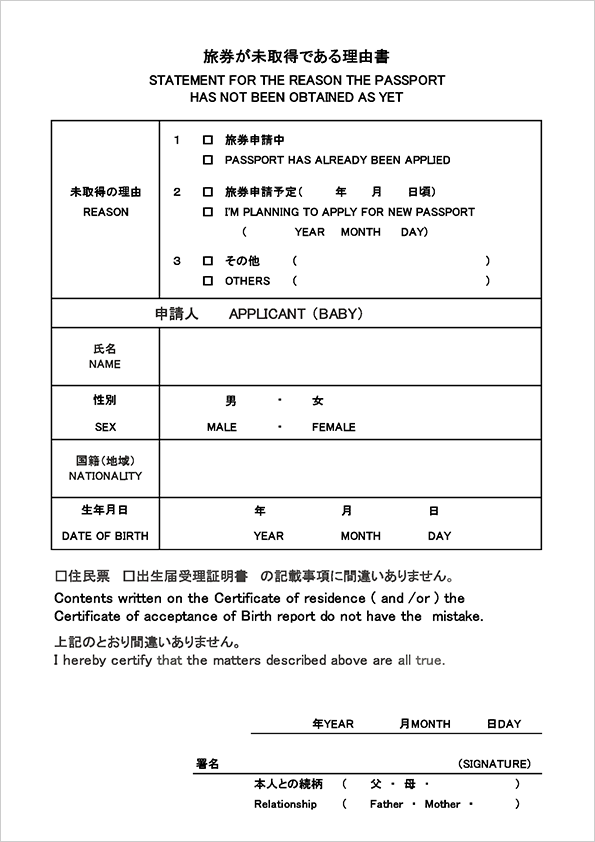
Your child's passport (from your home country's Embassy or consulate) or a receipt showing their passport is being processed (Statement example ).
Taxation Certificate (kazei shomeisho): issued within 3 months
Certification of Tax Payment (nozei shomeisho): issued within 3 months
Documents proving the person's occupation supporting the child: employment certificate or a certified copy of the company registry (tokibo tohon), etc.
Letter of Guarantee: This form is only submitted when one parent has PR, is a spouse or child of a Japanese national, is a permanent resident, or is a long-term resident (PDF ).
Residence card and passport of the person supporting the child
4. Register your child’s birth for your home country
Always confirm the birth registration documents with your home country's Embassy and consulate.
In general, you should prepare:
Birth (abroad) registration application
Passport application
Proof of child's birth: koseki tohon, shusshou todoke juri shomeisho, or shusshou todoke kisai jiko shomeisho (English translated if needed)
Married certificate
Proof of parent's citizenship
You can check if there is a consultation with an administrative lawyer to help you collect and complete the necessary documents.
Frequently asked questions
How do I get a copy of my birth certificate in Japan?
You can get two forms from your city hall or municipal office: the shusshō todoke juri shōmei-sho (the Birth Notification Acceptance Certificate) and the shusshou todoke kisai jiko shomeisho (the Certificate of Birth Report)
Do Japanese have a birth certificate?
Japan does not have a standard birth certificate. Most Japanese people use their koseki tohon, the family register, as the official record of birth. As of March 2024, a revised koseki law allows people to request family register documents at any municipal office in Japan, not just the city office of their registered domicile. This means you no longer need to travel to a specific city hall to obtain a koseki tohon, which is a significant practical improvement for people whose registered domicile is far from their current address.
What happens if a US citizen gives birth in Japan?
When a foreigner gives birth in Japan, if they are not married to a Japanese person, their child will not receive Japanese citizenship. For citizenship purposes, the foreigner will need to file a report with their home country's Embassy in Japan to receive their respective citizenship.
How much does it cost to get a birth certificate in Japan?
Japan does not issue a traditional birth certificate, but the equivalent documents can be obtained at a low cost. A koseki tohon (family register extract) costs approximately 450 yen per page at a municipal office. A Birth Notification Acceptance Certificate (shusshō todoke juri shōmei-sho) or Certificate of Birth Report (shusshou todoke kisai jiko shomei-sho) typically costs between 300 and 500 yen per copy. These fees apply whether you request them at the city office of your registered domicile or at any other municipal office in Japan following the March 2024 koseki reform. There is no fee for submitting the initial birth notification itself.
Does Japan issue birth certificates in English?
No. All birth-related documents in Japan, including the koseki tohon, the Birth Notification Acceptance Certificate, and the Certificate of Birth Report, are issued in Japanese only. There is no official English version of any of these documents. If you need to submit a Japanese birth document to a foreign authority, such as a home country embassy or a foreign government office, you will need a certified translation into the required language. Contact your home country's embassy or consulate in Japan to confirm what type of certified translation is accepted for your specific purpose, as requirements vary by country.
Can I get a Japanese birth certificate online?
As of August 2024, parents can submit a birth notification online via Japan's MynaPortal system without visiting a municipal office in person. This applies to the initial birth registration and requires that the municipal office of the parent's registered domicile supports the online system. For obtaining copies of existing birth documents such as a koseki tohon or birth notification certificate after the fact, online requests are also becoming more available through the MynaPortal and municipal digital services, though availability varies by municipality. Check your local city office website to confirm which services are available online in your area.
In closing
While there isn't a typical Japanese birth certificate, as there are other forms that Japanese people use, knowing how to register your child's birth in Japan and the other steps help lessen the mental burden of all the paperwork needed in Japan.
For specific details and forms, please refer to your municipal offices about birth certificates and your home country's Embassy and consult on registering your child's birth abroad.
Spending too long figuring out your Japanese mail?
Virtual mail + translation services start at 3800 per month. 30-day money-back guarantee.